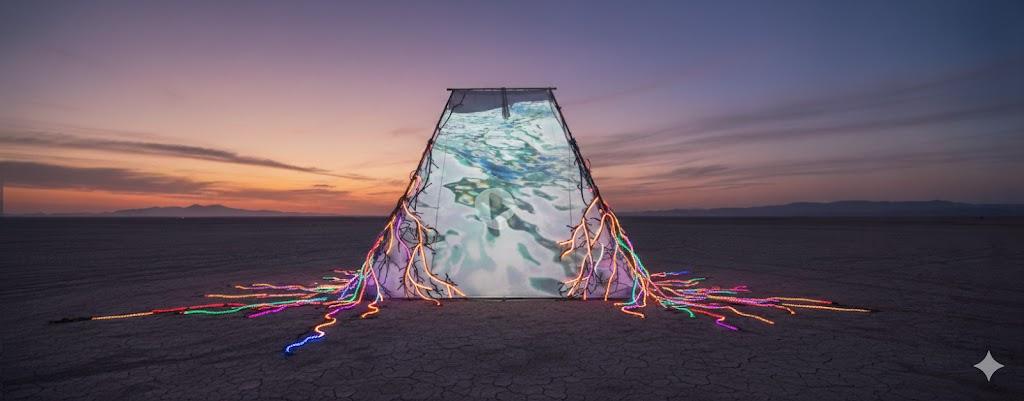
House of Umbra is an installation that brings art and performance from the ethereal to the real. This piece is designed to bring stage performance to the ground level. The House is a 11.42ft height – 95 sq.ft triangular prism with shadow screens on three of its sides. This is a space for dancers, musicians, artists and participants to design a performance in real time. A kaleidoscope of abstract colours and designs are projected on the inside of the structure. Dancers, movers and aerialists play with projections showing the distortion and abstraction of the body, using shadows to facilitate. They transform the House into a space that illuminates their movement, drawing attention to their bodies amongst vibrant projections that create shadows. It is also interactive, a chance for audiences to create and embody sound and images. Passers can enter the structure and play behind the screens. This prism shines bright in the desert, illuminating bodies and creating shadows. Come search for this bright light on your journey and dance in a sea of colour. House of Umbra is an interactive light installation that welcomes all kinds of performers to get lost in its light.
The Crossing consists of two groupings of elements. A rigid line cuts through the landscape, a boundary that may represent law, structure, or control. Intersecting this line are more organic forms that rise irregularly, as though shaped by wind, erosion, or time. The line may be read as a border or a threshold, a boundary between order and chaos, captivity and freedom, life and death. Movement unfolds across this divide. From one perspective, the passage across the line could represent departure or exile, figures leaving something familiar behind. From another, the same movement may suggest arrival, a transition toward possibility and renewal. The Crossing comes together through shared effort, people learning, experimenting, problem-solving, and physically constructing something at scale. It exists because of a community, for a short time, shaped by the desert and the people within it. As with many desert installations, the sculpture is intended to transform through fire. When it ultimately burns, the work completes its own crossing, shifting from structure into flame, light, and ash.