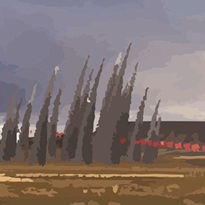
The Crossing consists of two groupings of elements. A rigid line cuts through the landscape, a boundary that may represent law, structure, or control. Intersecting this line are more organic forms that rise irregularly, as though shaped by wind, erosion, or time.
The line may be read as a border or a threshold, a boundary between order and chaos, captivity and freedom, life and death. Movement unfolds across this divide. From one perspective, the passage across the line could represent departure or exile, figures leaving something familiar behind. From another, the same movement may suggest arrival, a transition toward possibility and renewal.
The Crossing comes together through shared effort, people learning, experimenting, problem-solving, and physically constructing something at scale. It exists because of a community, for a short time, shaped by the desert and the people within it.
As with many desert installations, the sculpture is intended to transform through fire. When it ultimately burns, the work completes its own crossing, shifting from structure into flame, light, and ash.