
What Is the Clan?
The Clan is a sculptural representation of a San rock painting, which we understand to represent unity of intent and is the chosen central effigy at the annual AfrikaBurn event.
It is a vital part of our creative infrastructure – and it’s important that it matches the strategic pathway of AfrikaBurn, an ever-evolving work in creating the world anew.
The Clan is a commissioned artwork, carrying the opportunity and responsibility to be an agent of transformation, and as such, comes with support of additional inputs for the build crew.
The Clan is a tool for development and legacy, and it’s our mission to make sure that the values it portrays are relevant in the world and specifically in the South-African context.
As the icon of AfrikaBurn’s identity since its first event in 2007, it stands as a uniquely South African symbol as a recognisable San figure.
But where did it come from, what does it mean – and why and how did AfrikaBurn come to choose it as the icon that represents its identity?
Please read the History of The Clan.
Since its inception, the Clan project has been championed and interpreted by different artists each year, which has created a diversity of experience and expression.
This is an invitation for you to bring your idea into the diversity of the Clan and add to the collective expression that shapes the Clan as a whole.
A. Process Overview
An overly simplistic short version of how it happens
Proposal submissions
Who: You — everyone is invited to submit a Clan proposal.
What: An outline of the concept, design and execution plan for the Clan.
How: Submit by email.
Adjudication
Who: ArtCom sub-committee: Clan Team (minimum three people).
What: Assessment based on build experience, concept, design, construction and cost.
Planning
Who: Clan Artist in collaboration with the Clan Team.
What: Appoint a Clan Project Manager and develop the detailed budget and timeline.
Actualisation
Who: The Clan Crew.
What: Admin, logistics, crew management, build, lights, burn and site clean-up.
When: Fully ready ten days before the event; burn Saturday at 8 PM.
Reporting
Who: Clan Artist and/or Clan Project Manager.
What: Budget reconciliation plus Monitoring & Evaluation.
When: End of June.
Time Matters
Reinventing the world is a nurturing process. It doesn’t make sense to keep squeezing it into tight timelines — it stifles creativity and shortens the impact.
Adding time to planning and refining the process can significantly alleviate the financial and personal pressures associated with building large artworks in the desert.
Time and process are potent tools for meaningful and sustainable change. The intention is to extend the Clan process to allow for a more thoughtful and sustainable approach.
B. About the Sculpture
A burning artwork — not simply an artwork that can burn
The Design
It should be worthy — beautiful, inspirational and a conscious manifestation of AfrikaBurn’s guiding principles.
It’s a Burning Artwork: it must work as a sculpture and as a burn. Ideally the Clan is a 3D sculpture viewable from all sides.
The preferred minimum height is 15m. Consider proportions, the relationship to people and setting, the space beneath and around it, and a possible reference to the theme.
The design must remain a recognisable approximation and interpretation of the Clan motif.
Materials
Use waste, recycled and environmentally friendly materials wherever possible.
Materials must also make sense from a burn perspective. Avoid high-glue or high-chemical-content materials such as MDF.
What is the Clan?
The Clan is a sculptural representation of a San rock painting, which we understand to represent unity of intent, and is the chosen central effigy at the annual AfrikaBurn event.
It is a vital part of our creative infrastructure — a commissioned artwork carrying the opportunity and responsibility to be an agent of transformation.
The Clan is also a tool for development and legacy, with a mission to make sure the values it portrays remain relevant in the world and specifically in the South African context.
As the icon of AfrikaBurn’s identity since the first event in 2007, it stands as a uniquely South African symbol and a recognisable San figure.
Since its inception, different artists have championed and interpreted the Clan each year. This is an invitation to bring your idea into that diversity and add to the collective expression that shapes the Clan as a whole.
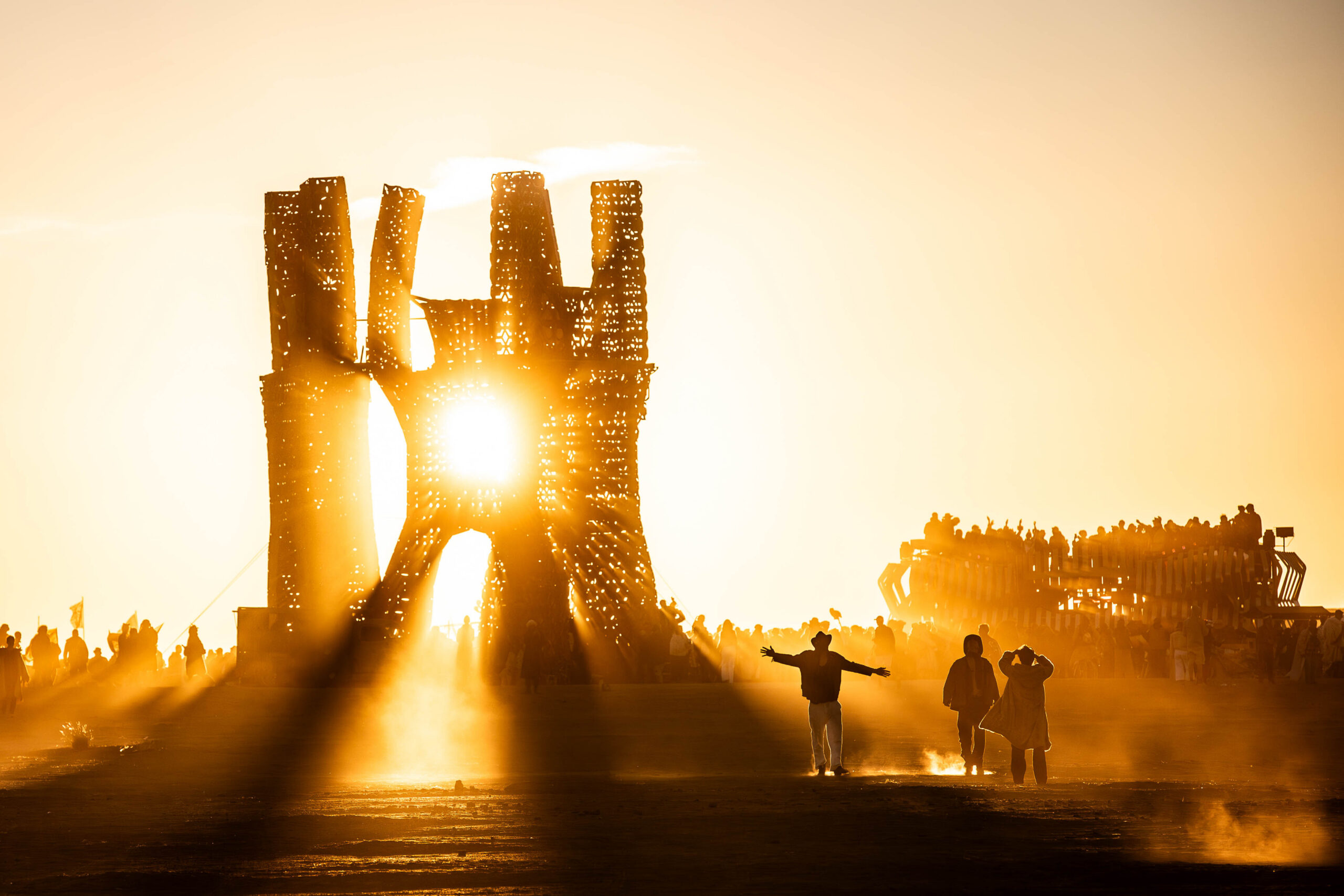
Clan Ubuntu – AfrikaBurn 2027 by Neo Monnapule & crew
Photo: Jonx Pillemer
Burn
The Clan is a sculptural fire. Burning is as integral to the design as structural and aesthetic considerations.
Consider how the sculpture should burn and fall, the duration of the burn, priming time, ignition points and any performance aspect.
Use the knowledge accumulated by the fire teams over years of experience.
Lights
Lighting is part of the sculpture aesthetically and for safety, and can make a large dent in the budget if it is not planned early.
Consider removal before the burn, cost, output, maintenance, environmental impact and the placement and security of the power source.
The Team
This enormous piece needs to be constructed. Consider AfrikaBurn’s ethos in your team building.
Projects that promote skills exchange across a diverse team are encouraged. Ideally the project will create opportunities and develop skills.
Bringing in paid professional contractors and service providers is not encouraged. Collaborate.
AfrikaBurn 2024 Clan by Sean Marais & crew
Photo: Anatol Gottfried
C. About Cultural Relevance
Radical Inclusion & the Two-Part Budget
The Clan budget has two parts: 1) the artwork and 2) social or community development through the artwork.
Community development is not compulsory and should not be forced on the artist, while equitable disbursement of the available funds is preserved.
75% — Artwork
Hard costs of producing the actual Clan sculpture.
25% — Community development
Reserved for an incubation or community-development element.
Three-quarters of the funds budgeted for the Clan are allocated to the hard costs of producing the sculpture.
One-quarter is reserved for community development. Proposals without an incubation element do not have access to this portion, which can then be redirected to projects that do.
Incubation projects are not ordinary projects built with cheap labour by people from previously disadvantaged backgrounds. They require specific concepts and outcomes, responsibilities and accountability. Not every artist can or should take this on.
The two-part model is intended to acknowledge the diverse strengths, circumstances, motivations and learning processes of the artist community. Everyone is invited to submit a Clan proposal.
D. About the Proposal
What’s a Clan Proposal?
A Clan proposal is a written document submitted to the AfrikaBurn Art Portfolio, expressing your intention to design and build the Clan and how you envision it.
It is a comprehensive description through words and pictures or drawings that lets ArtCom understand the idea.
If shortlisted
AfrikaBurn will ask for more information as necessary. At the initial stage, the level of detail does not need to be equal across every topic.
If selected
After final details are agreed, the Clan Proposal, detailed Budget and rigorous Timeline are appended to the Clan Grant Agreement.
Structural drawings will be required. What is built must be what was pitched and/or agreed, particularly around design and budget.
Please be honest
Be clear and upfront about what you are capable of technically and practically.
AfrikaBurn wants to help safely actualise the vision; it might not be the Clan, and it might not be this year.
Your initial proposal is unlikely to be the final one. Request input when needed and accept feedback from ArtCom.
Design and build may differ
AfrikaBurn is open to the possibility that the design and build of the Clan are separate and handled by different crews. Say so in the proposal if this applies.
Key Elements to Include in Your Clan Proposal
1. The Concept
The core idea behind the Clan: cultural meaning, artistic vision, philosophical statement, social impact and desired outcomes.
2. The Design
Describe size, shape, structure, colours and other key features. Consider proportions, scale and interaction with the surroundings.
3. Images
Include visual aids that show the intended image and proportions. Technical drawings are welcome, but a handmade drawing on a serviette will also do.
4. Materials & Sustainability
Specify planned materials and their environmental impact. Consider the burn perspective and avoid materials with high chemical content.
5. Lighting
Outline the night lighting plan for aesthetics and safety, including projections or enhanced visual effects if relevant.
6. Burn Plan
Explain how the sculpture will burn and fall, how long collapse may take, and the ignition or performance plan.
7. Technical Considerations
Outline wind load, anchor points and erection plan. Indicate whether heavy lifting equipment or riggers may be needed.
8. Execution Plan
Include timelines, milestones, kidney stones, key activities, resources, materials and any external support required.
9. Budget
Provide a breakdown of expenses.
10. The People
Give a brief bio of yourself and your team: default-world work, AfrikaBurn and other experience, skill set, dreams, motivations and anything else relevant.
Submitting & Updating Your Clan Proposal
Email: clan@afrikaburn.com, CC art@afrikaburn.com
Subject: 2027 Clan Proposal – [Project Name] or [Your Name] or anything we can easily refer to
One email thread only: if you add, change or update anything, return to the original thread.
Deadline: Sunday, 30 August 2026 at midnight.
Additional Pearls of Knowledge
Two rules worth remembering
Clan Rule Nº ONE: Don’t underestimate the TIME this will take.
Clan Rule Nº TWO: Keep track of your BUDGET from the start.
- Working in the desert is harder than in a controlled environment and will take longer than you imagine.
- Make provision for weather days and allow plenty of time for the finish.
- Do as much prep work as possible beforehand in town.
- If you can, plan a dry run in town so structural and assembly problems can be found while shops and resources are still available.
- By the time you reach the desert, you should be reassembling a puzzle you have already solved.
- Focus on constructing the Clan first, and additional sculptural elements second.
- The Clan burns on Saturday night, weather permitting.
- Ignition is the Artist’s choice in consultation with the Art Committee.
- Performances around ignition are open to collaborators and handled by the artist with ArtCom support if needed.
- The Clan Crew is responsible for cleaning the Clan site.
- After the event, complete the full budget reconciliation with supporting slips and the Monitoring & Evaluation report.
To All the Clan Artists
A history of Clan builders
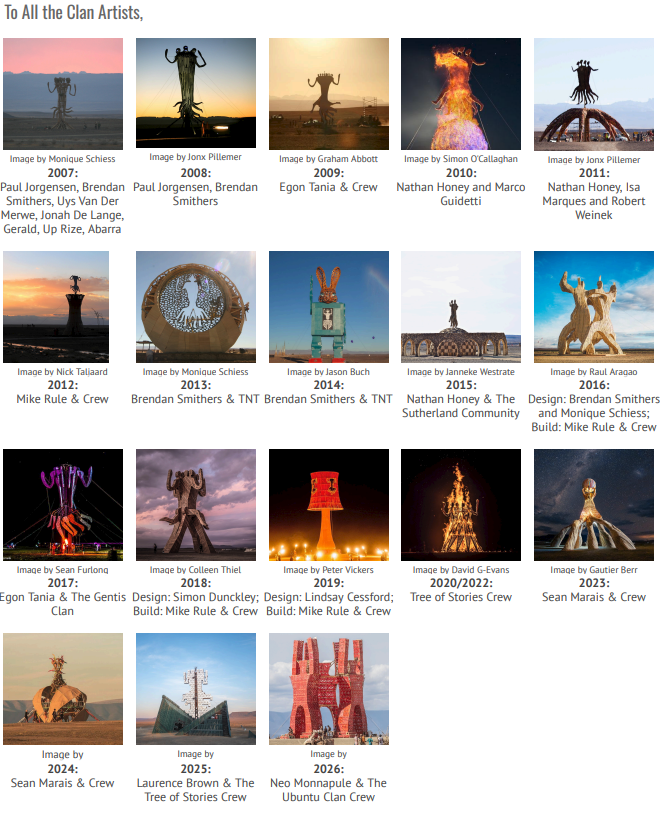
2007
Paul Jorgensen, Brendan Smithers, Uys Van Der Merwe, Jonah De Lange, Gerald, Up Rize, Abarra
2008
Paul Jorgensen, Brendan Smithers
2009
Egon Tania & Crew
2010
Nathan Honey and Marco Guidetti
2011
Nathan Honey, Isa Marques and Robert Weinek
2012
Mike Rule & Crew
2013
Brendan Smithers & TNT
2014
Brendan Smithers & TNT
2015
Nathan Honey & The Sutherland Community
2016
Design: Brendan Smithers and Monique Schiess; Build: Mike Rule & Crew
2017
Egon Tania & The Gentis Clan
2018
Design: Simon Dunckley; Build: Mike Rule & Crew
2019
Design: Lindsay Cessford; Build: Mike Rule & Crew
2020/2022
Tree of Stories Crew
2023
Sean Marais & Crew
2024
Sean Marais & Crew
2025
Laurence Brown & The Tree of Stories Crew
2026
Neo Monnapule & The Ubuntu Clan Crew