
A space of intense presence and emotional release.
“The pages, the words, the pain and memories and intentions, all gone. The space they held, swept clean.
In that moment: death. In that moment, life. And where there’s life, there’s always a whisper of hope.”
— Leonie Joubert, Curly the ’Burner in Burning the Karoo
What is the Temple?
The Temple is a Space
The Temple has developed as part of AfrikaBurn’s physical and emotional landscape as a space of contemplation and reflection: a sanctuary, a site of calm on the edge of the chaos and cacophony of Tankwa Town.
It is a space to spend time with one’s own thoughts, reflect on one’s life, the lives of others, those recently passed, and ancestors. It should inspire us and stimulate spiritual awareness of nature and the cosmos.
While the structure may be a thing of beauty, its significance is in its transience. It is a place of letting go and release — the pinnacle of our celebration of immediacy and catharsis.
The Temple is a commissioned artwork carrying the opportunity and responsibility to be an agent of transformation. It is also a tool for development and legacy, with a mission to ensure that the values it embodies remain relevant in the world, specifically in the South African cultural landscape.
This is an invitation to submit a Temple Proposal. Everyone is invited to submit, but building the Temple is a serious undertaking. The assessment process differs from creative-grant adjudication and involves greater deliberation and an open dialogue with applicant artists as concepts develop.
SPACE
Culture
The Temple is a non-religious, neutral, inclusive and equitable space.
Apart from opening and closing ceremonies before the burn, it is best suited to personal or small-group ceremonies that do not dominate the space. It should remain accessible throughout the event so participants can use it for their own ceremony, even while others are present.
PLACE
Placement
A quiet and reflective place, the Temple is usually placed on the outskirts of Tankwa Town to offer a pilgrimage to a remote locale. It has also been placed in the middle before and consciously activated as a spiritual space to good effect.
FORM
Structure
The Temple can be anything. It should be inspiring and have some structure. A sense of “meaningful enclosure” offering shelter and safety is recommended.
Designers should consider surfaces for writing, placing meaningful objects and sitting, and a boundary or perimeter that creates a precinct free from mutant vehicles and bicycles.
LIFE
Care & activation
Activation matters as much as structure. The Temple needs care, cleaning and attention throughout the week. Consider guardians or custodians to hold the space, clean each morning, maintain lighting, check interaction and support appropriate rituals.
The burn
At opening, the Temple is a clean slate. By the end it is covered in words, feelings, photographs, objects of remembrance and bits of human existence. Many find solace and catharsis here.
There is one official ritual in the Temple: burning it, on Sunday night. The Temple burn is intended as a silent event for the community. The silence ushers in a sense of the sacred and reverence, giving those witnessing it a pause to reflect and turn inward.
The artist may choose to use sound as an element within the Temple, but this should be discussed with ArtCom in advance. The burning of the Temple structure should be done consciously.
“The Temple burn is an example of something that became an unintentionally ritualised icon because our energy made it so.”
— Simon Bannister, Temple Artist
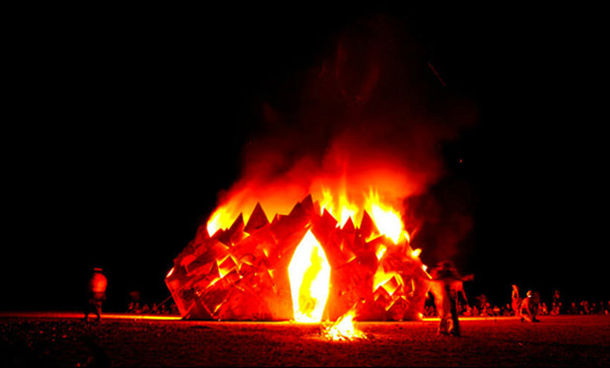
Image credit: Simon Max Bannister
A. About Intent
Building the Temple is a labour of love
We encourage the designer and their crew to incorporate positive intention into the practice and process of the Temple’s design and build.
We believe that the motivation and thought that go into the design, coupled with the collective energy that creates the space and builds the structure, are reflected in the integrity of the Temple and the ritual it hosts.
“Once it is built, it belongs to the community.”
One of the most important aspects of building the Temple is to remember that while the design initially comes from the artist’s vision and the builders’ sweat and tears, once it is built it belongs to the community.
— Burning Man
The structure of the Temple
The term “Temple” arose to describe a sacred space or precinct consecrated for ritual purposes. Originally, templum referred to a specific area “cut off or seperated”; over time it evolved to refer to structures built within these sacred spaces.
Contemplatio (Latin noun, derived from CON + Templum): con- means “with” or “together”; -templum refers to a sacred space or precinct. The prefix suggests deep engagement or unity with the object of contemplation, while the root hints at the sacred or introspective nature of the activity.
Carl Jung describes the temenos as a “square space” where profound mental work can happen, comparing it to a “magic circle”: a protected environment for psychological exploration, contemplation and inner reflection.
B. About the Sculpture
A burning artwork — not simply an artwork that can burn
DESIGN
The design
- It should be worthy: beautiful, inspirational, a conscious manifestation of AfrikaBurn’s guiding principles.
- It is a Burning Artwork — it must work as a sculpture and as a burn.
- Ideally, it is a 3D sculpture viewable from all sides.
- Consider proportions, people, setting, and the space beneath and around the Temple.
- While not a design criterion, consider a reference to the annual theme.
MATERIALS
Materials
Use waste, recycled and environmentally friendly materials wherever possible.
Consider materials from a burn perspective. Avoid high-glue or high-chemical-content materials such as MDF.
LIGHT
Lights
Lighting is part of the sculpture aesthetically and for safety, and can make a significant dent in the budget if not planned early.
- Plan removal of lights before the burn.
- Balance cost, output, maintenance, reuse and environmental impact.
- Place the power source so it does not disturb the piece visually or through sound, and protect it from damage and non-consensual borrowing.
PEOPLE
The team
Consider AfrikaBurn’s ethos when building the team. Projects that promote skills exchange across a diverse team are encouraged.
Paid professional contractors and service providers are not encouraged. Collaboration can fill skill gaps and elevate the piece.
Burn plan questions
- How would you like the sculpture to burn — and fall?
- What is the duration of the burn? Too long and people lose focus; too short and people miss it.
- How will it be lit? Consider priming time, ignition points, performance aspects and how these interact.
A burning artwork is conceptualised and built as a burning artwork. It comes alive when set alight, makes sense as fire, and requires very little accelerant. AfrikaBurn’s accumulated fire-team knowledge is available to artists; make use of it.
C. About Cultural and Social Context
A Temple of Change
Radical Inclusion & the two-part budget
The two parts are: 1) The Artwork and 2) Community Development through the Artwork. Community development is not compulsory; it is an opportunity for artists who are willing and able. Its purpose is to incubate participation through resource mobilisation towards equitable engagement.
The model is intended to make provision for different circumstances, motivations and learning processes, acknowledging diverse strengths and encouraging artists AfrikaBurn may wish to include.
AfrikaBurn’s Radical Inclusion principle is specifically adapted for the South African and African continental context: “Everyone should be able to be a part of AfrikaBurn. As an intentional community, committed to inventing the world anew, we actively pursue mechanisms to address imbalances and overcome barriers to participation, especially in light of past, current and systemic injustice. We welcome and respect the stranger. Anyone can belong.”
As a commissioned work, the Temple is an opportunity to further Radical Inclusion through Participation, Radical Self Expression and Each One Teaching One.
In a nutshell, three-quarters of the funds budgeted for the Temple in the AfrikaBurn Annual Budget are allocated to the hard costs of producing the sculpture. A quarter is reserved for community development. Proposals without an incubation element do not have access to that quarter; it can be redirected to projects that do. The construction budget therefore remains the same for everyone.
Incubation Projects are not normal projects built with cheap labour by people from previously disadvantaged backgrounds. They are projects with specific concepts and outcomes, with responsibilities and accountability. Not all artists can or should take this on.
D. About the Proposal
What’s a Temple Proposal?
A Temple Proposal is a document submitted to the AfrikaBurn Art Portfolio expressing your intention to design and build the Temple and how you envision it. It is a comprehensive description, through words and pictures, that lets ArtCom understand your idea.
Proposals are received, held and considered for the future. A new interval review process is being developed and will be communicated. This is intended to allow strong ideas to remain in view for further engagement and inclusion of community-development initiatives.
At the initial stage, not every topic requires the same level of detail. AfrikaBurn needs an idea of your plan — and your ability to make one — not your truck’s ETA in Tankwa. If shortlisted, you will be asked for more information as necessary.
SELECTION
If selected
- Final details, a detailed Budget and rigorous Timeline will be appended to the Temple Grant Agreement.
- You will be required to provide structural drawings.
- What you build must be what was pitched and/or agreed to, particularly around design and budget.
HONESTY
Please be honest
Be clear and upfront about what you are capable of technically and practically. The guidelines specifically discourage AI visualisation because it can make an inadequate structure appear plausible.
The aim is to help you safely actualise your vision. Your initial proposal is unlikely to be the final one: request input and accept feedback from ArtCom.
Key elements to include
The core idea behind the Temple. What is the Cultural Meaning, Artistic Vision, Philosophical Statement and Social Impact? What are the potential or desired outcomes?
Describe size, shape, structure, colours and other key features. Consider proportions, scale and interaction with the surroundings.
Include visual aids that show the intended image and proportions. Technical drawings are welcome, but a handmade drawing can also work. Cite and caption reference images. The guidelines discourage AI for development of the design.
Specify planned materials and environmental impact. Consider the burn perspective and avoid materials with high chemical content.
Outline the night lighting plan for aesthetics and safety, including projections or enhanced visual effects if relevant.
Explain how the sculpture will burn and fall, how long collapse may take, and the ignition and performance plan.
Outline wind load, anchor points and erection plan. Indicate whether heavy lifting equipment or riggers may be needed.
Include timelines, milestones, kidney stones, key activities, resources, materials and any external support required.
Provide a breakdown of expenses.
Give a brief bio of yourself and your team: your default-world work, AfrikaBurn and other experience, skill set, dreams, motivations and anything else relevant.
Submitting & updating your proposal
Email: temple@afrikaburn.com, CC art@afrikaburn.com
Subject: Temple Proposal – [Project Name] or [Your Name] or anything ArtCom can refer to.
One email thread only: all information, changes and updates about a proposal should stay in the original thread.
Temple proposals are accepted year-round as part of an ongoing review process supporting longer-term planning and proposal development. Submission does not guarantee or imply approval or selection for a future Temple.

A history of Temples at AfrikaBurn
Brad Baard & Peter Hayes
Monique Schiess & Brad Baard
Adriaan Wessels
Simon Bannister and crew
Simon Bannister and crew
Simon Bannister and crew
Verity Maud and crew
Verity Maud and crew
Walter Böhmer and crew
Kim Goodwin and The Dandylions
Walter Böhmer & The Starlight Collective
Carmel Ives and crew
Carmel Ives and The Temple Crew
Carmel Ives and The Temple Crew
Chantal Berill & DPW Temple Crew
Ceduma Qamata & The Temple Crew
In 2007, a Temple was built by Brad Baard and Peter Hayes. That year, the Clan was not completed in time for a Saturday burn, and Brad and Peter allowed the Temple to burn on Saturday instead.
In 2009, Brad Baard and Monique Schiess built The Temporal. It was not called “the temple”, though its stated intention was to be a quiet, reflective space. In 2011, Adriaan Wessels built his pyramid Temple structure.
A discussion followed across ArtCom and the broader AfrikaBurn organisation about whether to solicit a temple space. The decision at the time was not to issue a callout, but to support one if it arose from the community.
Simon Bannister created Solace in 2012, followed by Compression and The Offering in 2013 and 2014. In 2015, Verity Maud led a deliberately activated Temple placed in the middle of the city. In 2017, Walter Böhmer and crew created the Temple of Gratitude; the source history also records Anushka Kempken and crew creating Oasis in 2018.
In 2019, Walter Böhmer and The Starlight Collective created Temple of Stars. The burn moved to Sunday at the artist’s request to enable a space for catharsis, and a perimeter was used to hold the space.
Carmel Ives designed Gaia’s Song for AfrikaBurn 2020. After two years without the Burn during the Covid pandemic, it was realised in 2022. Carmel and crew then designed and built the Temple in 2023 and 2024.
Further reading
A starting point, not a canon
Further Reading
Have a Temple in you?
Send AfrikaBurn ArtCom your proposal, keep every update in the same email thread, and expect dialogue as the idea develops.